
The Forward RPC-based TOF detector (fRPC-TOF) of HADES was built to extend the spectrometer’s acceptance at very low polar angles, enabling the study of hyperon resonances and double-strange baryon production in proton-proton reactions at a few GeV beam energy. The fRPC-TOF is based on the well-established HADES RPC technology,
ensuring high efficiency and excellent timing performance. To cope with the expected high particle flux near the beam axis, the detector employs thinner glass electrodes and is operated above room temperature, reducing glass resistivity and significantly enhancing the counting rate capability—an approach never previously implemented in a full-size RPC system. Modular design with overlapping coverage ensures no efficiency gaps, while the system is thermally stabilized using a hot-water circulation system monitored with PID-controlled temperature sensors. Signals from each cell are read out via front-end electronics and TDC boards, allowing precise time-of-flight measurements for particle identification. The fRPC-TOF thus combines proven RPC technology with an innovative thermal operation concept, enabling reliable measurements of forward-emitted reaction products under high-rate conditions. This approach represents a significant advancement in RPC detector operation and opens new possibilities for experiments requiring high-rate, high-precision timing detection in compact forward regions..
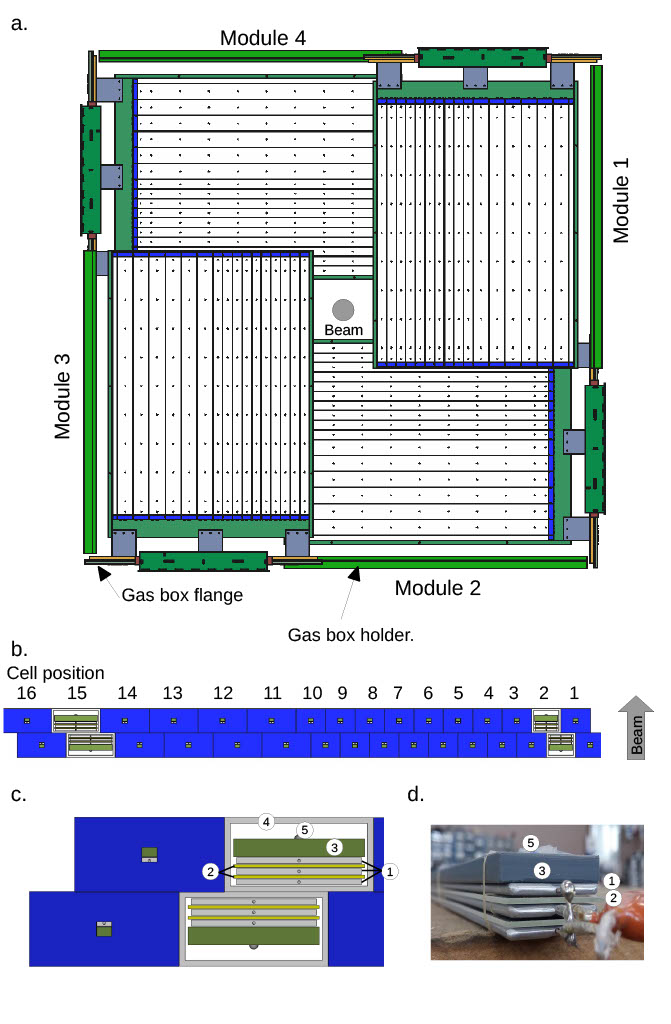 a. Arrangement of the modules around the beam axis (gas box not shown) from the target point of view.
b. Cross-section of a module showing the distribution of 32 cells in two layers. Twenty 22 mm wide cells near the beam axis and twelve 44 mm wide cells in the peripheral part.
c. CAD detail of two of the cells inside the aluminum tube without end-shields.
d. Actual photograph of one of the cells showing: 1- aluminum electrodes, 2- glass electrodes, 3- PVC pressure plate, 4- 2 mm thick aluminum shielding tube and 5- compression springs.
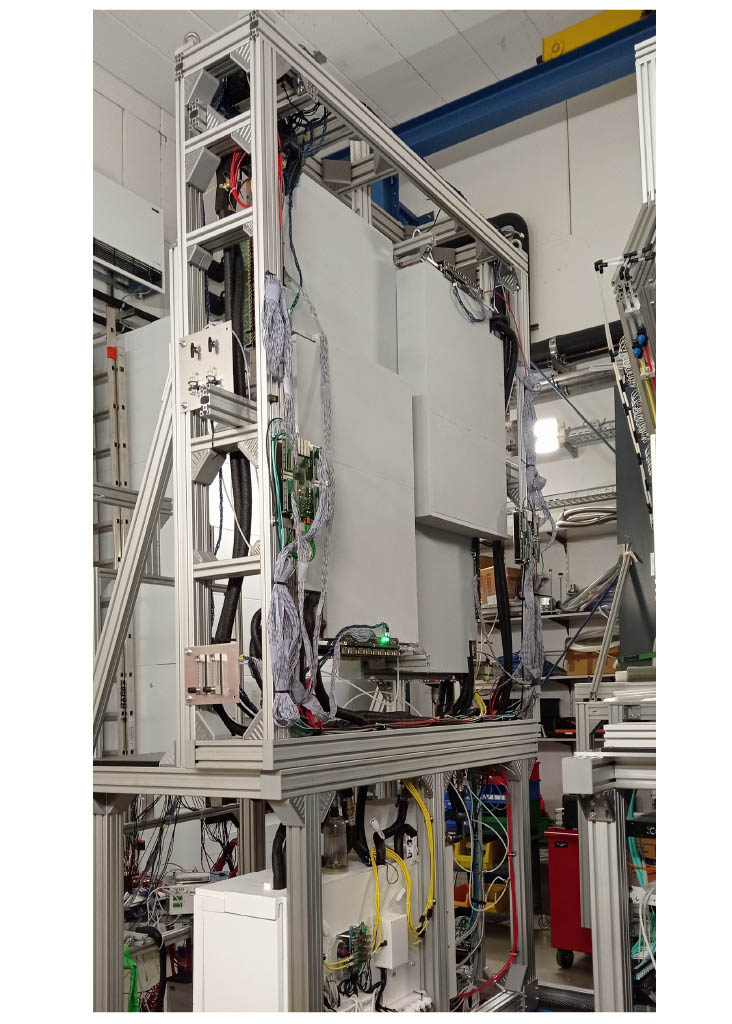
fRPC installed at the forward of the HADES spectrometer. On the lower trolley is installed the heating and pump system (white box) and the communication and power supply systems. On the upper gantry are the four modules with the XPS insulation together with the FEE and the two TRB boards.