
The HADES inner Time-of-Flight (TOF) wall represents a milestone in the application of Resistive Plate Chamber (RPC) technology for high-precision timing in high-multiplicity heavy-ion experiments. It was the first large-area detector to employ a fully segmented array of individually shielded, multi-gap timing RPCs operated in a double-layer configuration, a concept never before realized in a full-scale TOF system. This innovative design was driven by the stringent requirements of the HADES experiment, combining high granularity, excellent time resolution, and robust multi-hit capability under moderate-
to-high particle flux conditions.
The detector covers an active area of approximately 8 m² and comprises 1116 variable-geometry, symmetric four-gap RPC cells, read out through more than 2200 time and charge channels. A key novelty lies in the individual electromagnetic shielding of each strip-like RPC cell, an approach specifically developed to suppress signal crosstalk inherent to high-bandwidth timing RPCs. While such shielding introduces inactive regions, the challenge was overcome by adopting a carefully optimized two-layer staggered geometry, ensuring full acceptance without efficiency losses. This concept enabled, for the first time, effective cluster sizes close to unity in a large RPC-based TOF detector.
The detector achievea a single-hit efficiency above 95% and a time resolution at the level of 100 ps or better, fulfilling the most demanding HADES requirements. Crosstalk probabilities were reduced to a few percent, with measurable improvements in both time and position resolution in fully shielded regions, highlighting the critical impact of the novel shielding concept. The system also showed reliable multi-hit performance, essential for operation in high-multiplicity heavy-ion collisions.
Overall, the HADES inner TOF wall established RPC technology as a mature and scalable solution for precision time-of-flight measurements. Its pioneering concepts—individual cell shielding, effective cluster size control, and double-layer redundancy—set new standards for RPC-based detectors and laid the foundation for subsequent high-performance TOF systems in nuclear and hadron physics experiments.
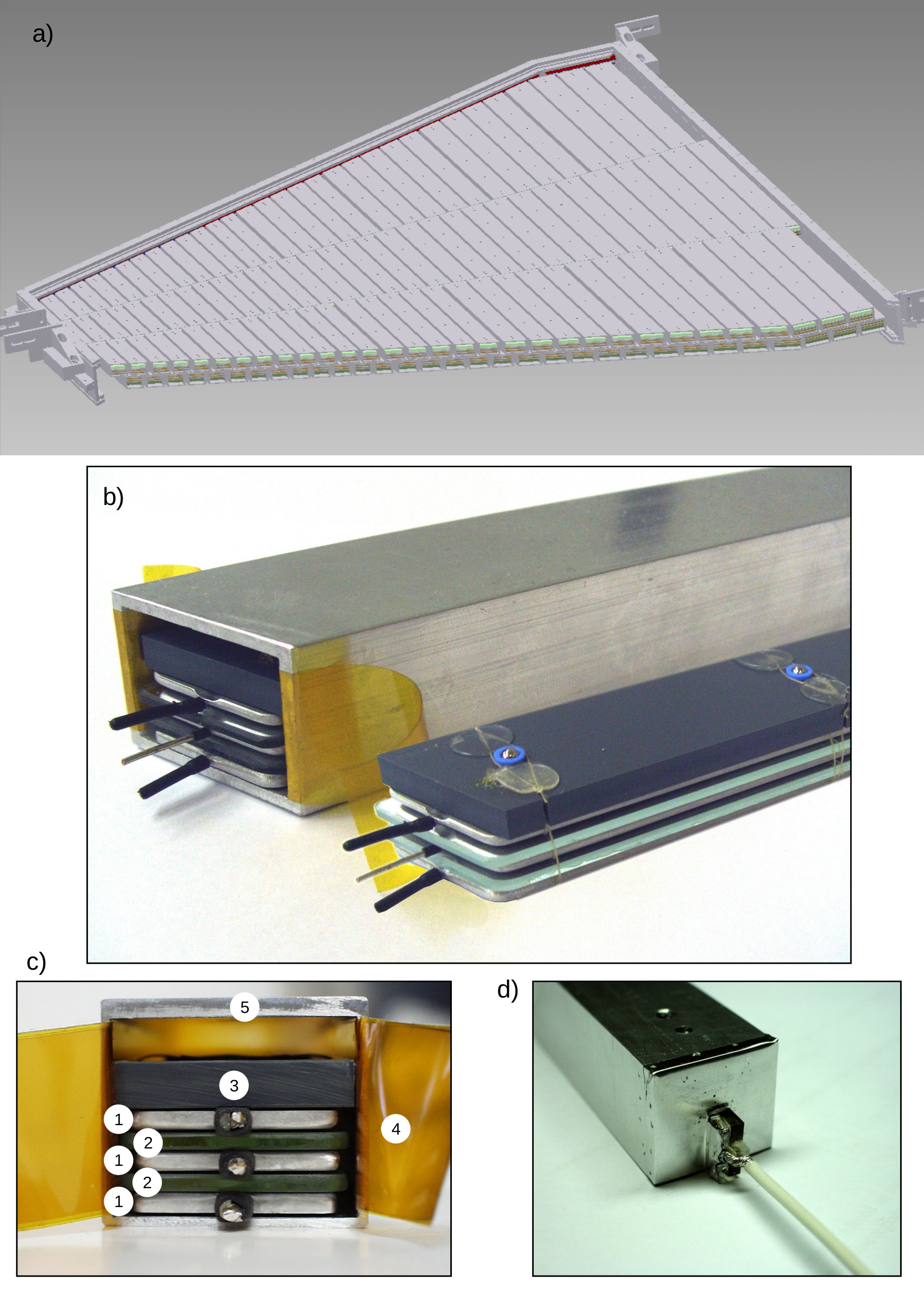
a. Drawing of the internal structure of one HADES RPC sector and also parts of the gas box. The detector is composed by individually shielded strip-like counters (cells), organized in two partially overlapping layers with 31 rows and 3 columns each. The counters variable width matches the expected local particle density.
b. One of the cells after assembly, before and after being inserted into the aluminum tube.
c. Internal structure of the cells: 1—Al electrodes; 2—glass electrodes; 3—plastic pressure plate; 4—kapton insulation; 5—2 mm thick Al shielding tube.
d. Finished detector with Al foil shielding end-cap and HV cable.
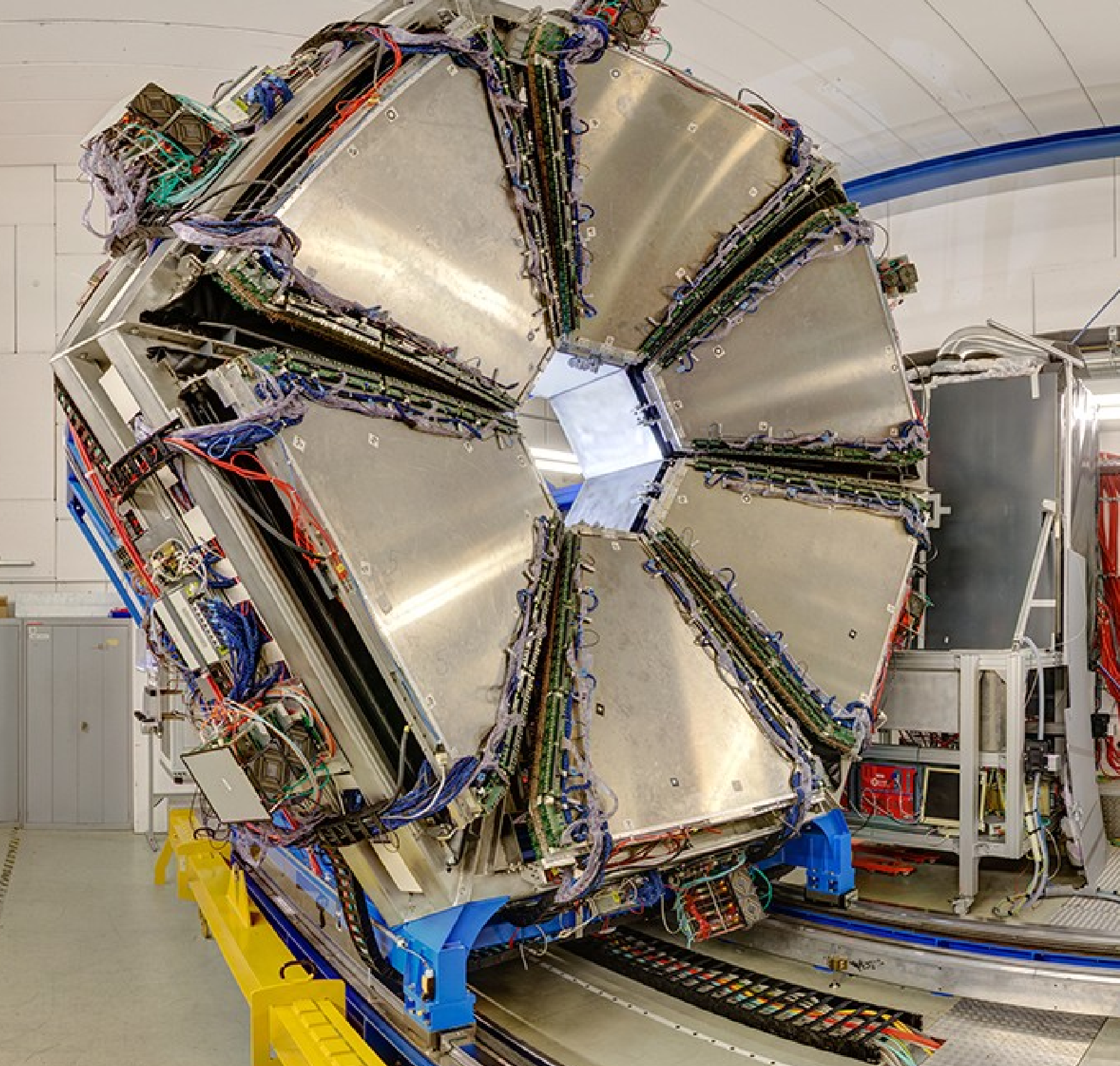
RPC-TOF mounted on HADES