
The HADES Collaboration has measured the production and lifetimes of the light hypernuclei 3ΛH (hypertriton) and 4ΛH in Ag+Ag collisions at √sNN = 2.55 GeV. Hypernuclei contain a Λ hyperon in addition to protons and neutrons and therefore provide a unique laboratory for studying the hyperon–nucleon interaction and strange nuclear matter.
From 2.6 billion collisions, HADES reconstructed about 1000 hypertritons and 4000 4ΛH nuclei. The signals reach statistical significances of 16.8 and 38.0, respectively, enabling a multidifferential analysis of their production in this energy regime.
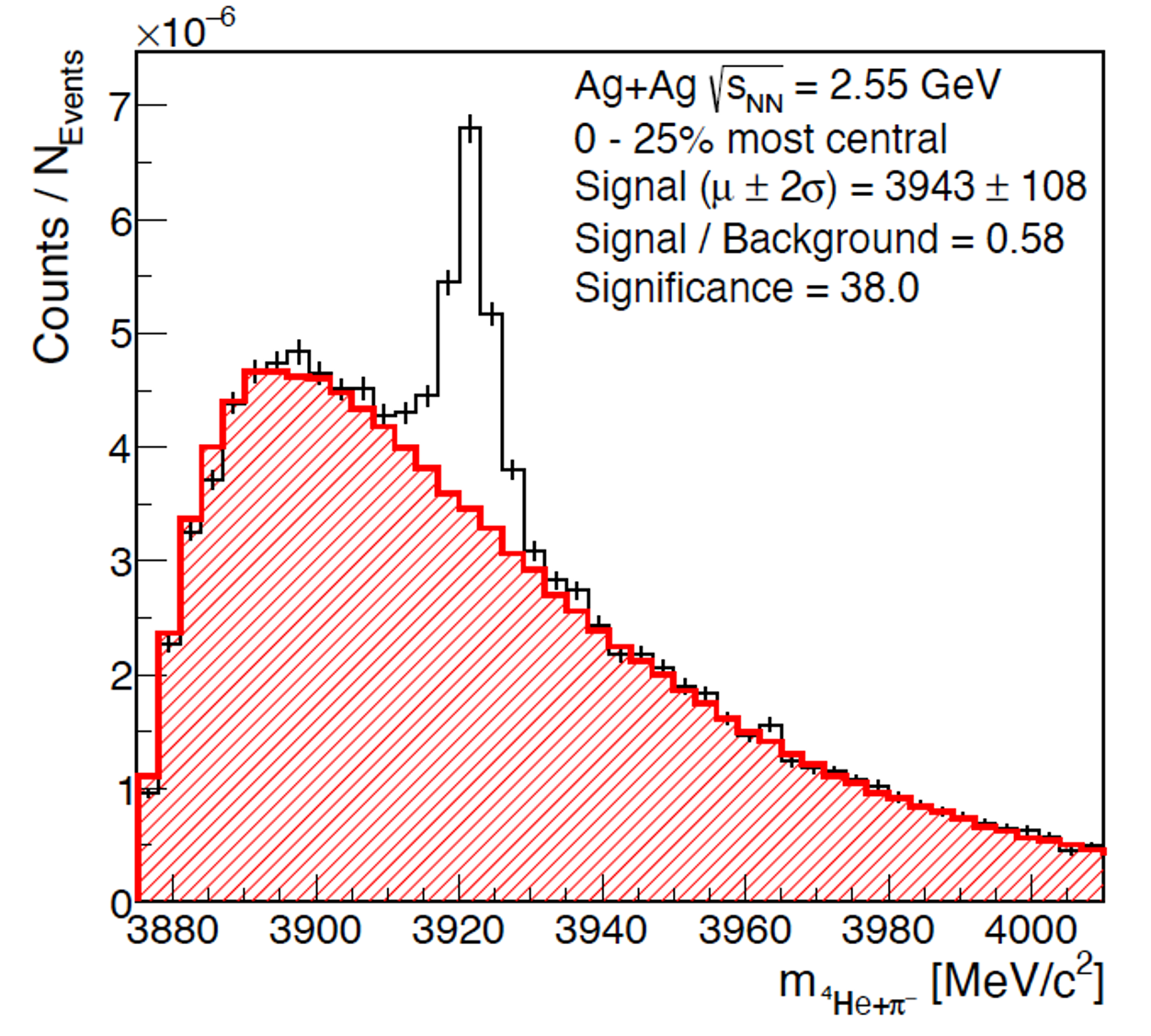
A particularly interesting result is the relative production yield: the 4ΛH yield is at least as large as that of the hypertriton. One possible explanation is feed-down from excited A = 4 hypernuclear states.
The measured lifetimes are:
- τ(3ΛH) = 217 ± 19 (stat.) ± 17 (syst.) ps
- τ(4ΛH) = 191 ± 6 (stat.) ± 12 (syst.) ps
While the hypertriton lifetime is compatible with that of a free Λ hyperon within uncertainties, the 4ΛH lifetime is 4.5 standard deviations shorter.
The measurement is performed just below the expected maximum of light-hypernucleus production at collision energies of a few GeV, a region that will be explored systematically at high interaction rates by CBM at FAIR.